Showing posts with label krazy kat. Show all posts

30 November 2013

Out of the Vaults: From Binko to Bluto

Omigosh... a Gerstein blogpost! They've been rarer than hen's teeth for quite awhile, and some of you know why—I've spent the last year stretched between quite a lot of publishing projects. But Ramapith updates couldn't stay extinct forever. After all, new research discoveries are still what I live for.
      And look for.

Just for instance—I've been looking for lost scenes. Thanks to the help of Tom Stathes, Mark Kausler, and others, I'm pleased to present here a rare Columbia Krazy Kat cartoon—The Katnips of 1940 (1934)—without original titles (sorry!) but with two musical numbers we don't usually see.
    The Busby Berkeley-like "Dance of the Girl With the Fan" seems to have made it past the Hays Code, but was dropped from the commonly seen TV print. So was "What a New Deal," celebrating (what else?) the New Deal and the end of Prohibition.


Moving on, let's see—I've been looking for lost films. The Romer Grey animation studio is almost unknown today; set up in 1930 by the son of Wild West novelist Zane Grey, it started work on four cartoons featuring the Mickeylike character Binko the Bear Cub. While Binko himself was a cheerful nonentity, Grey provided early employment for more than a dozen famous animators, including Bob McKimson, Tom McKimson, Preston Blair, Pete Burness, Jack Zander, Cal Dalton, and Riley Thomson. Many of these talents' very first animation was on Binko cartoons.
      The four films that went into production—Arabian Nightmare, Hot-Toe Mollie, Binko the Toreador and Sand Witches (all 1930-31)—are often described as never completed; Michael Mallory has referred to the first two as "ready to be duped."
      I'm pleased to report that somehow, Hot-Toe Mollie made it past that stage; and not long ago I located a mostly complete print in a private collection. I don't have good quality footage yet, but here's your first glimpse of this long-lost Binko adventure:


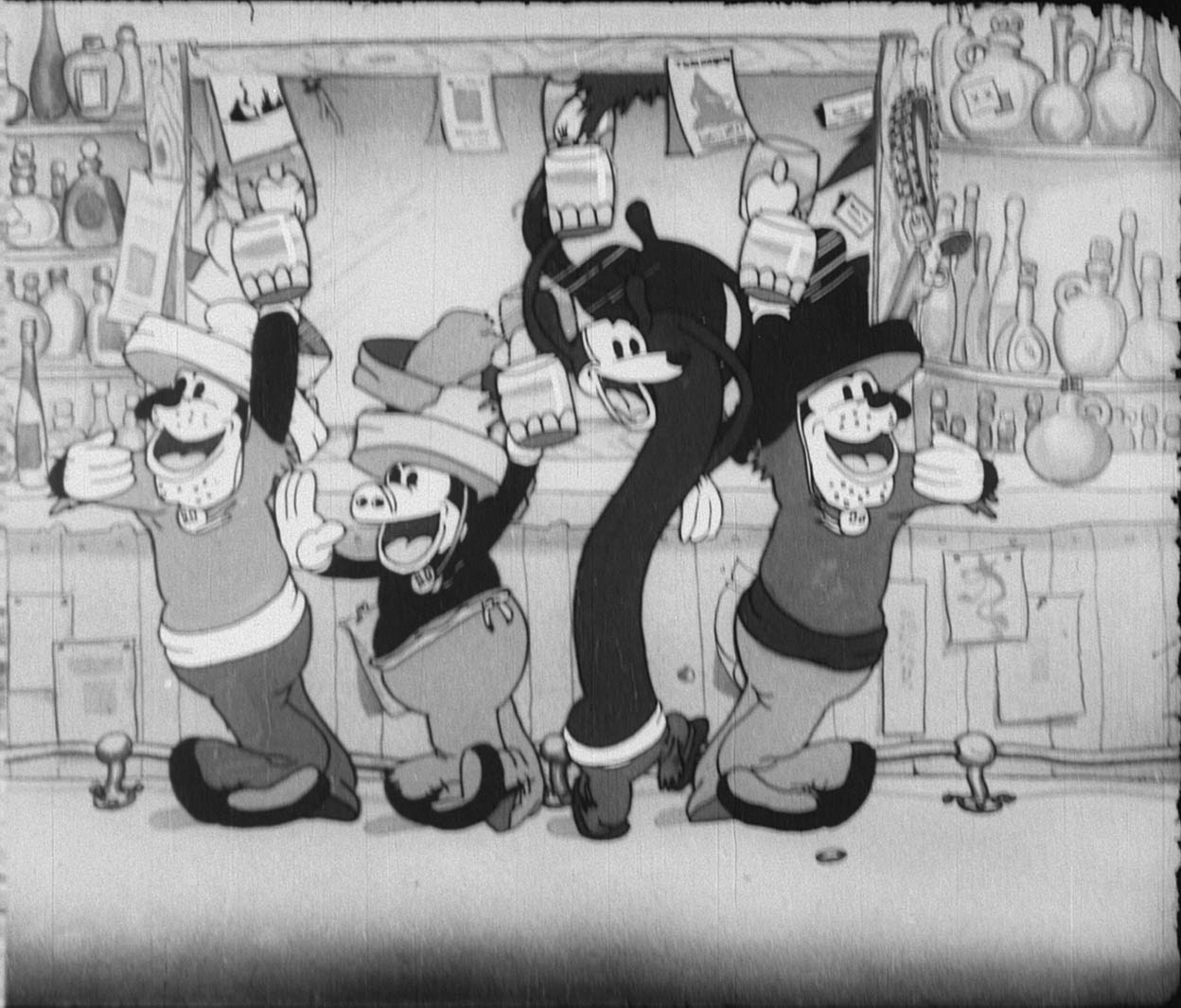
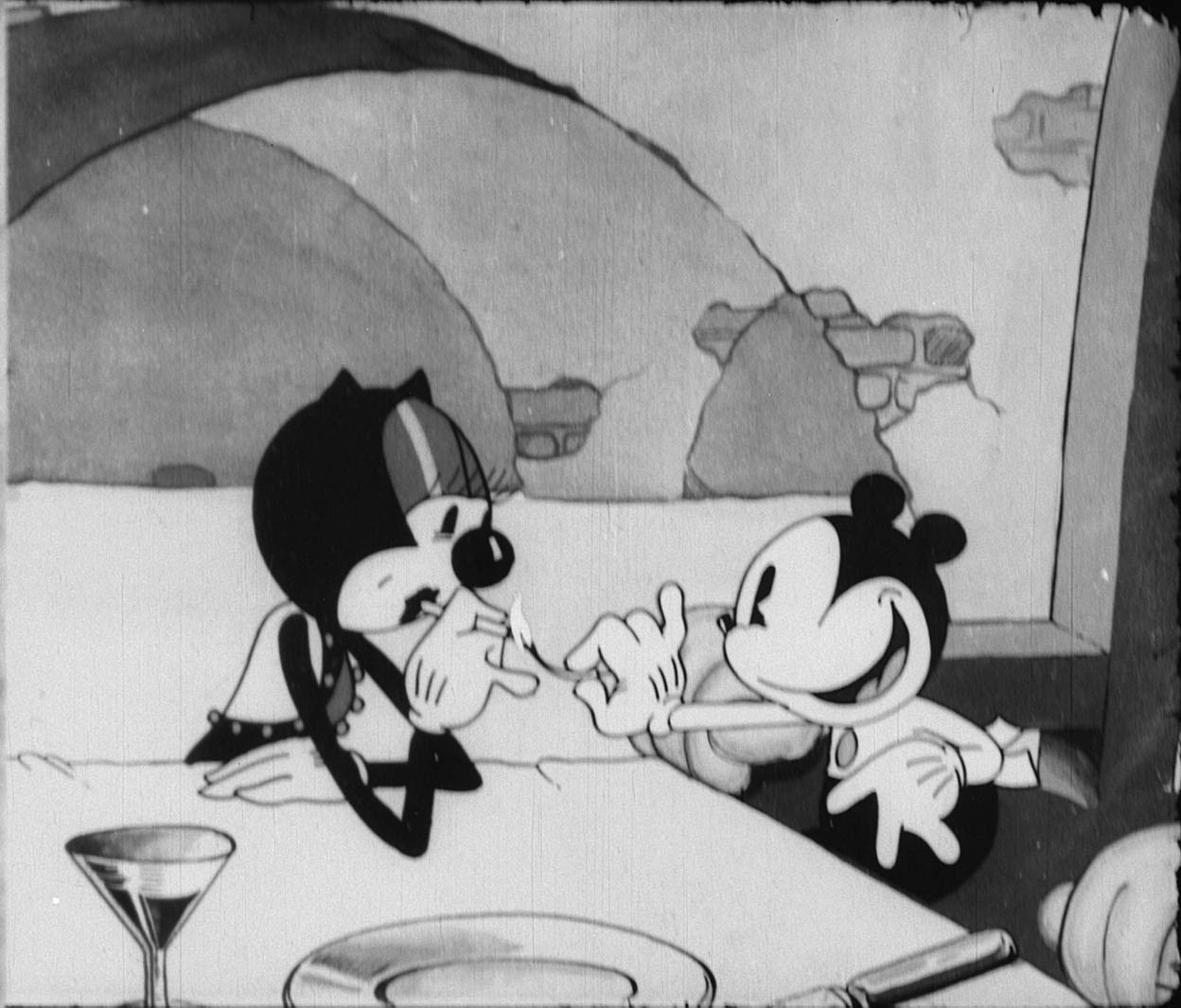
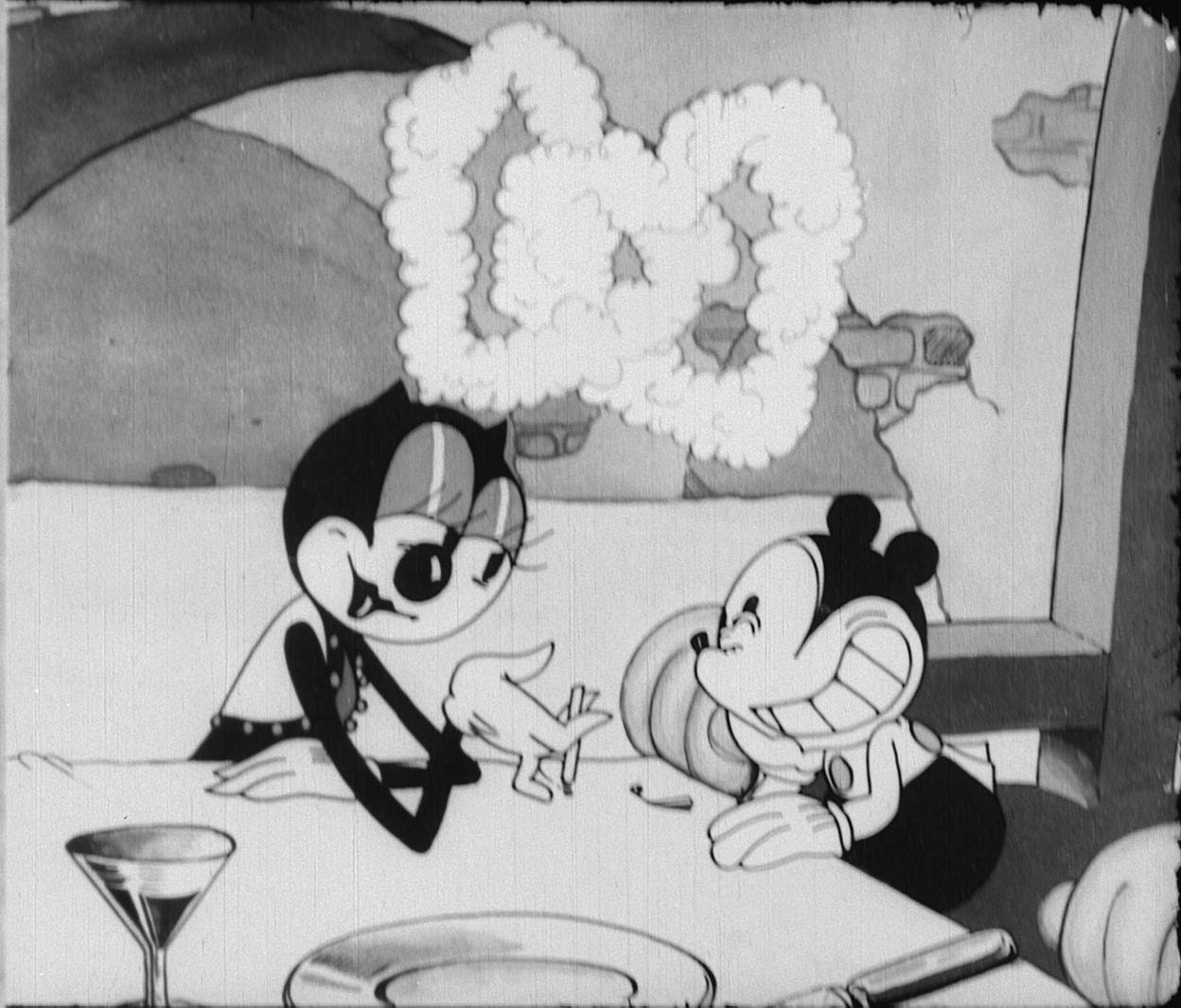


(From one obscure studio to another: animation of the galloping donkey [image 2] was reused in Boyd La Vero's Mexicali Lilly [1932], a Marty Monk cartoon. What was the connection? Animator Cal Dalton worked for both Grey and La Vero.)

Those of you near Michigan might get to see Hot-Toe Mollie in an hour! As of a last-minute decision, my friend and colleague Steve Stanchfield will be premiering our newly recovered element in "Out of the Inkwell, Out of the Vaults": a screening this afternoon at the Detroit Film Theatre. Mollie will be shown in the last third of the screening (likely around 3:45 PM), so if you're nearby, drop in! I promised to put up this post as a kind of program note.
      If you can't make it to Detroit immediately, don't worry—Mollie will appear before too long on an exciting DVD project. Keep your white-gloved fingers crossed.

(Update Dec 1: Steve's Detroit show went over nicely. Thanks for coming, all.)

Now where was I? Oh, yeah—I've been looking for lost facts. Hey, maybe it's time for another installment of that infamous Ramapith "subseries"... Legendbreakers!


Legend: In 1938, infamous Popeye nemesis Bluto lost his voice—literally!—due to the death of Fleischer voice artist Gus Wickie. We're not sure how Wickie died... but as of 1938, he was gone, gone, gone. Blow me down!

Status: FALSE.

Examples:
[Leslie Cabarga, The Fleischer Story, 1988]
"Gus Wickie [was] the baritone member of a vocal quartette used by Paramount. It is Wickie's deep voice and heartily wicked laugh that is most familiar to fans of the Fleischer Popeye cartoons. When Wickie died several others filled in..."


[Tim Lawson, The Magic Behind the Voices, 2004]

"[When] former vaudeville singer Gus Wickie... passed away, others tried their hand at the [Bluto] role..."


[Wikipedia, as of 30 Nov 2013]

"[Wickie] was the voice of Bluto in the Fleischer Studios Popeye cartoons from 1935 until his death in 1938."

Origins: The story of Wickie dying in 1938... where did it get started? I'm away from my older notes and resources at the moment, and will update this blogpost later. But for now, let's presume the concept originated in Fleischer staffers' later memories—which, it seems, weren't quite right. A January 8, 1947 Variety obituary (!) corrects the record. And, like many other documents, it corrects a certain surname...

Gus Wicke's 1917 draft card. Image
courtesy Don M. Yowp
August Wicke, as per his 1917 draft card, was born May 7, 1885. Wicke came Stateside in 1887 with his carpenter father, also named August. At some point before 1917, our Gus took a wife named Margaret, nicknamed May. Also before 1917, our Gus lost his right eye—much like a future spinach-eating foe.

(Update 11/30/13: Thanks to fellow cartoon researcher Don M. Yowp for Wicke's draft registration card, which included the discoveries of his missing eye and exact birthdate. I previously had only "abt 1886," from a 1940 census. Great finds, Don.)

The young adult Gus was an entertainer from the start. As early as September 9, 1916 (in a story dated 9/2/16), Billboard cites Wicke as a cast member in The Big Show, a Charles Dillingham production at the Hippodrome theatre. Then on February 6, 1926 (in a story dated 1/30/26), Billboard notes the debut of "The Westerners, a five-people harmony, singing and comedy offering with Gus Wicke, late of the Texas Four, which act recently broke up..."
      In 1929, Billboard (7/13), the Boston Globe (9/8) and other papers noted Wicke "among the principals" in R. H. Burnside's "mammoth" production Here and There. In 1931, Billboard (1/3) finds Wicke in the Hammerstein musical comedy Ballyhoo—playing a "Mr. Pidgeon," though we don't learn whether the character was a bearded sailor.

Mid-1930s texts again reference Wicke's role in a quartet. Billboard 7/22/36: "...Jerry White, Gus Wicke, Fred Bishop and Paul Davin, the Gay Nineties quartet, have been renewed at that New York night spot by Bill Hardy..."
      These same texts confirm that Wicke and the legendary "Wickie" are one and the same. On February 5, 1938, The New York Post described the opening of the Radio Franks Club, "marking the reunion of the radio harmony team of Frank Bessinger and Jerry White, hosts... [performers include] the 'Mauve Decade' Quartet, featuring Gus 'Popeye' Wicke and Fred Bishop."
      On February 13, the New York Times refers to the Franks Club and "Gus Wickie [sic], the swell bass"... and, apparently, the origin of the misspelling.
      The Brooklyn Eagle's "Manhattan Night Spots" column on January 20, 1939 covers the Radio Franks once more—again mentioning "Gus (Popeye) Wicke, comic." It seems Wicke was known more for being a Popeye cast member than for voicing Bluto specifically. Or maybe Wicke, in 1939, simply rode the presumption that he actually voiced Popeye?

Wait a minute—1939! Yes... after 1938, it is clear now that Wicke simply went on living. "This New York," in the Charleston Daily Mail for June 20, once again references "Gus Wicke, whose foghorn voice makes bullfrogs turn greener with envy."
      The New York Herald Tribune on February 21, 1940 states that "...Bill Hardy will fete Spike Harrison, Gus Wicke and Fred Bishop tonight in honor of their five years of service." Billboard's 1/10/42 nightclub reviews cite Wicke again and name Hardy's club: Bill's Gay Nineties.
      A portrait begins to emerge: Gus Wicke was a highly popular entertainer, featured at Bill's Gay Nineties—but also at the Radio Franks and elsewhere. His quartet teammates included Bishop, Harrison, and a rotating fourth member.
      His popularity seems to have been such that he didn't need animation. The Fleischer studio moved to Florida; "Bluto" stayed behind in Nassau, New York—though, like his cartoon counterpart, he did his villainous bit for the war effort. Billboard's February 19, 1944 "American Theatre Wing" lists Wicke among those who entertained the troops.

What didn't Gus Wicke do? He didn't sail on the SS Dresden from Bremen to Detroit in 1893, nor was he a 17-year-old farmer at the time; that was an unrelated August Wicke. He didn't live for decades in Albany, New York with a wife named Caroline (in 1920) and a wife named Elizabeth (in 1935). That was another unrelated August Wicke, who was never in Germany and was born in New York in 1889.

With all that out of the way, we return to the "real" Fleischer Gus Wicke—and his January 8, 1947 Variety obituary, which backs up the other new finds by reporting his age as 61. The man we know best as a thuggish pirate made quite a nice, honest living for himself, don't you think? I wonder if his wife May was tall and thin, with short black hair and a long nose.

This blogpost has been brought to you by the way I'm really making a living...


...editing and writing a variety of Disney, animation- and comic-related reference books, including Fantagraphics' Floyd Gottfredson Library. Look to our latest two-volume set (also available as individual books) for the complete run of Gottfredson's Mickey Mouse color Sunday comics, 1932-38—plus his later Sunday miscellany, including stray Mickeys and feature film adaptations.
      There's always a new project in the works... and a new blaze to extinguish! I'm reminded, again, of Bluto—and his slogan in a pre-Wicke Popeye cartoon, The Two-Alarm Fire (1934):

      Rare and tear and yell and shout
      If there's a fire round about
      Rare and tear and yell and shout
      Then Company C will put it out!

04 June 2012

Cele-bray-ting Historic Silents


If my friends were asked to name my favorite cartoon stars, various high-pitched, black-furred animals might come to mind. But I'm also fascinated by a group of earlier, cruder, yet still endearing animated creations. Judge Rummy, Bobby Bumps, and Jerry on the Job were among the leading lights at Bray Studios, the first fullscale cartoon production house in the United States.
They are also almost completely forgotten today.

T'was not always thus, of course. Bray would never have gone fullscale had his films not been successful. J. R. Bray (1879-1978) cut his pop culture teeth in the early 1900s, with a variety of comic strips based on dachshunds. (We've all got to start somewhere.) From this he moved onward to his first successful Sunday newspaper series—Little Johnny and the Teddy Bears—and in 1913, his first animated shorts. Film number four, Colonel Heeza Liar in Africa (1913), introduced the first recurring American cartoon star, a windy little explorer who would feature on and off in Bray cartoons for some twelve years.


Bolstered by Heeza's growing success, Bray Studios expanded; cut distribution deals with the likes of Paramount and Goldwyn Pictures, and hired a raft of additional cartoonists and auteurs, all of whom were soon directing films of their own. Earl Hurd created Bobby Bumps and his dour dog Fido. Paul Terry flung Farmer Al Falfa into action. Max Fleischer created Koko the Clown, called only "the Goldwyn-Bray Clown" at the time.
But Bray's star-packed stable lost mileage fast. The demanding producer rarely saw eye-to-eye with his staffers; eventually, he found many of them departing to start their own studios, taking their characters with them. In time, Bray Studios moved into educational media. After a brief revival on 1950s TV, Bray's cartoon heyday became a footnote in history.

Of course, for me Bray is alive and well. For the past year, I've been heavily active with my friend Tom Stathes, founder of the Bray Animation Project website; and the business of rediscovering—and locating—their long-lost films has become a surprising, exciting adventure for us. Before now, it seemed few scholars noticed Bray. Today we are traveling from archive to archive: researching scrapbooks and production materials, making note of the studio's groundbreaking technical innovations and wry, often adult-themed content.
In the process of all this research, Tom and I have also sought out 16mm prints of the Bray subjects. Already known for his extensive silent cartoon library, Tom has a special focus on Bray, and I'm pleased to have helped him with his acquisitions. Now we're planning some exciting DVDs... but I say too much!


For the moment, the excitement is about the Bray Project's first anniversary. In just one year's time, the initiative has made exciting progress. Collectors with scarce prints have contacted us; even rare animation art has turned up—and with it some pleasant surprises.
Bray partner Earl Hurd patented the process of cel animation in late 1914. Cels allowed characters to be painted on transparent celluloid and laid over complex backgrounds; earlier, most cartoons consisted of line art, with simple backgrounds meticulously traced from picture to picture.

Colonel Heeza Liar, Dog Fancier (1915)
What many forget is that there was an intermediate step. Prior to Hurd's cel system, Bray attempted to patent a borderline process in which partial backgrounds—with gaps for the action to take place—were mechanically reprinted on translucent paper. Then animators filled in the gap on every sheet, "animat[ing] only the part of the scene that had to move" (Maltin, 1978). The sheets' translucent nature enabled them to be painted on the back, creating shading.
This method sounds easy in practice, but was cumbersome in execution; to a point in which it is often described as having been discarded after Bray's first several films. What a surprise, then, to find that Bray actually continued to use it, in various permutations, well into 1915 and for quite a number of shorts.


With Colonel Heeza Liar in Mexico (1914), the comparison of an unused background sheet with a finished frame show how Heeza and the stork were drawn and painted image by image. This wasn't so different from the later cel process. But with Bray's method, some nonmoving rooftops had to be repainted on every drawing, too.


For Rastus' Rabid Rabbit Hunt (1914), the printed background seems minimal: just a horizon line and a cow. But a close look at the back of the sheet—where ink lines vary in strength—reveals that Rastus (the sadly stereotyped African-American hunter) held still for this part of the shot, so he was printed as part of the background too. Poor Rastus had to be painted anew in every frame, even when totally motionless.
The cel system couldn't come soon enough.

Bray-era publicity drawing, 1916
There are more Bray discoveries looming up ahead—many more. For the moment, allow me to suggest that you come to Tom's next Cartoon Carnival screening, Friday, June 8—in which we'll feature a very rare Bray Katzenjammer Kids cartoon.

I'd also like to bring you one more Bray rarity right here, right now.

In 1920, following a deal with Hearst's International Film Service, the Bray studio began to produce Krazy Kat shorts; the second series of films with George Herriman's perennial patsy. Some are lost today; and some, like The Best Mouse Loses (1920), are most often seen in truncated, virtually plotless excerpts. The edited Best Mouse feels like a rudimentary exercise in animation: mice dance around a boxing ring, with no obvious rhyme or reason to their actions.
Now, with thanks to Tom and the Bray Animation Project, I'm pleased to share the complete The Best Mouse Loses—which actually features a sophisticated storyline. Ignatz Mouse has a cunning plan, his wife Magnolia has another... and poor Krazy Kat learns that it always hurts to help.


Some of you may remember the Bray name from some more famous mouse films. Thanks to his patents on the animation process, here's where he cropped up in 1932...


(Hey, is that an original end title? Yes—there's another big blogpost in the works, whenever I get time. Fingers crossed.)

As a final note, I'd like to ask that if you use any of this blogpost's Bray images elsewhere, you please credit Tom Stathes, myself, and the Bray Project. As the old proverb sort of goes:

Bray screen in the morning, Heeza's warning.
Bray screen at night, Heeza's delight!

15 May 2009

Not the Funniest Freleng: Krazy's Port Whines

Travel and intense research have me busy this week, so I haven't had much of a chance to post. But for your amusement (?) and edification, here now is Port Whines (1929), another of the earliest Columbia Krazy Kat shorts—and another that hasn't been seen with sound in decades.

See Jerry Beck's earlier post on Ratskin (1929) for the inside information on where the video element comes from (and why it looks the way it does). Thanks to Cole Johnson—and by extension, the Vitaphone Project—for supplying the audio. As before, I handled the editing, and while the two elements didn't always match, I did my best to stretch and splice and sync things up as they should be. The video element has British main titles, fascinating enough in and of themselves that I didn't want to put faux Columbia originals in their places.


Port Whines isn't the most exciting cartoon we'll ever see. Only a few moments of delightfully crude violence save us from a rather basic musicale. In fact, even as a song cartoon the film falls short; while Ratskin featured a lively mix of popular songs, the body of Port Whines is dominated by the public domain "Life on the Ocean Wave," "Sailing, Sailing," and "Pop Goes the Weasel."

Only the main title tune, "Me-Ow," is a licensed number—and even it would soon be replaced with Mintz's self-owned similar cue, "You Are the Kat's Meow" (first used in Kat's Meow, 1930).

Perhaps the most interesting moment comes at 3:45, where the rooster's smoke ring stunts look to be animated by none other than Friz Freleng. Freleng worked with Mintz's New York staff in 1929 while waiting for Harman and Ising to sell their Bosko the Talk-Ink Kid (1929) pilot; in Port Whines, Freleng's obviously West Coast, Oswald-inspired design style clashes with the other animators' work. By Farm Relief (1929), however—just two shorts later—the rest of the Krazy staff seems to be imitating Freleng, with various degrees of success. The trend would only continue when the studio moved west in early 1930, and more Los Angeles animators joined the relocated crew.

It's no mean tribute to Freleng, especially at this early stage of his career, that his brief sojourn at a foreign studio should have had such an influence. The formerly Fleischerian stock company of earlier Harrison and Gould, with its truly bizarre elephant and hippo characters, would never be quite the same.

06 May 2009

The Tammany Kat is Loose: Ratskin

Call him/her whatever gender you will—George Herriman's Krazy Kat is cartoondom's most famous masochist. When not reveling in the dubious joys of being bonked with a brick, Krazy is willfully undergoing other embarrassments. Employing Felix the Cat's voice double is just one example.

Jerry Beck, blogging at Cartoon Brew, is just now featuring a cartoon I've helped him "restore"—Ratskin (1929), Krazy's first sound short at Columbia. The Vitaphone Project recently recovered the film's long-lost soundtrack; Beck had his amateur video recording, and doing a little editing, I've aided in reuniting the two. And who knew? The usually far more kreative Krazy howls and yowls in a comically awful house cat impersonation, notable for its similarity to the poorly-received Felix "voice" Pat Sullivan employed at the time. Did the same actor meow badly for two New York studios? What was Charles Mintz thinking?

Maybe he felt it was the only way to tie into a famous song on the soundtrack! Ratskin is the first of many cartoons I know to enlist "Me-Ow," a 1909 pop tune by Harry Kerr and Mel B. Kaufman. Sylvester, Bosko, and Farmer Al Falfa have gamboled to this chestnut so often that almost every animation fan knows the melody—if not its name and theme. Here, courtesy of the invaluable UCSB Cylinder Archive, is Irving Kaufman performing the tune ten years after its creation:


Apart from being catchy in and of itself. "Me-Ow" exemplifies the bond between vintage cartoons and bygone cultural mores, a topic I'll be discussing fairly often here. In the early 1900s, cats weren't just household pets; they were equally common as strays, and thus seen as symbols of illness, savagery, and feral behavior. Of course, such behavior often mandated societal "punishment." So the image of the cat as comedic fall guy was also born at this time—but with an undercurrent of grotesque realism rarely present today. The drowned cat, sacked and tossed in the river, was a fact of life in 1910. So was the cat on a fence being battered with boots, and the randy cat slain by its multiple mates. In "Everybody Knows It's There," a David Reed tune recorded in 1908 by Edward M. Favor, the narrative could casually describe "every cat in town" being "slaughtered"—presumably as disease-carriers—and expect listeners simply to smile at the animals' bad luck.


In line with this, is it such a surprise that "Me-Ow!" is actually about a pet owner's unsuccessful efforts to kill his furry ward? Maybe it made Jerry Mouse's top ten.

Ratskin also features other popular songs of its era, some of which Cartoon Brew has listed for us. But I'd like to draw your attention to another that fascinates me: "Tammany." Dating from the worst period of Tammany Hall graft, Gus Edwards' and Vincent Bryan's tune likens political thugs to the lawless Indians of racist stereotype—an obvious comparison, given the Tammany society's use of Native American terminology. By the time of the later Merrie Melodie Bowery Bugs (1949), "Tammany" had simply become a tune evoking a late-19th-century slicker; in Ratskin, its original meaning was still remembered, thus its tongue-in-cheek use with an actual Wild West scenario. Here it is as performed by Billy Murray, later the voice of Bimbo, in 1905:


Hmm, it seems I've strayed rather far from Coconino County here. Then again, so would Columbia's version of Krazy Kat. Quick, Ignatz... the brick!

[Updated—thanks to Cole Johnson for corrections re: the Tammany society's Native American connection.]